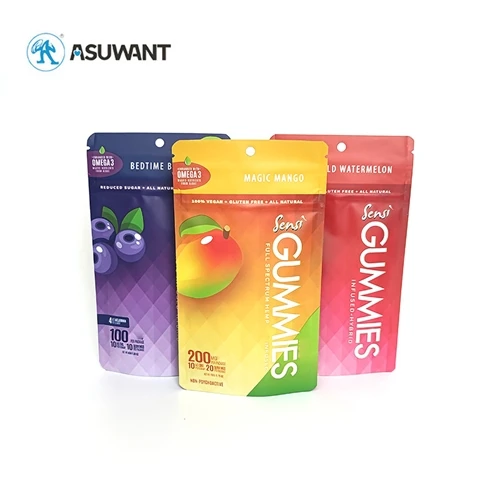
In the food foreign trade industry, packaging bags are not only protective shells for products, but also an intuitive reflection of brand image and product quality. Different food ingredients, shelf lives and transportation scenarios require matched packaging materials. Choosing the right material can reduce transportation losses, extend food shelf life, and meet environmental protection and compliance requirements of overseas markets.
1. PE (Polyethylene) Material
PE is the most basic and widely used food packaging material with high cost performance. It is soft, tough, non-toxic and odorless, featuring excellent heat-sealing and moisture-proof properties. With great cold resistance, it does not crack in low-temperature environments, ideal for frozen food, dry goods and snacks. Its lightweight feature also effectively reduces logistics costs.
However, PE has poor puncture and high-temperature resistance, and is prone to deformation under high temperature. Single-layer PE has weak oxygen and light barrier performance, failing to meet high fresh-keeping and long-shelf-life requirements. It is usually used for short-term food storage or as the inner layer of composite packaging.
2. PET (Polyester) Material
PET is a mainstream outer layer material for high-end food packaging. It has high transparency and gloss, presenting excellent printing and color rendering effects to enhance product appearance and brand texture. With high mechanical strength, tear and stretch resistance, and stable temperature adaptability, it is safe for most normal-temperature and refrigerated food. Its chemical stability prevents reactions with food contents.
The disadvantage is that single-layer PET lacks sufficient moisture and oxygen barrier capacity and poor heat-sealing performance. It cannot be used alone for food requiring high fresh-keeping performance, and needs to be compounded with PE or CPP, leading to higher packaging costs than pure PE bags.
3. Aluminum Foil / Aluminized Composite Material
It is the preferred material for food requiring high barrier performance and long shelf life, widely used for tea, nuts, cooked food and vacuum meat products. It provides excellent light, oxygen, moisture and heat insulation, effectively locking food flavor and greatly extending shelf life. It also features high temperature resistance, strong puncture resistance and superior sealing performance.
Its drawbacks include zero transparency (unable to display internal products), relatively high cost, poor flexibility, and difficult recycling. It is not suitable for lightweight and low-priced food products.
4. PA (Nylon) Material
Nylon features high strength, outstanding puncture resistance, oil resistance and high-temperature resistance, with far better toughness than ordinary plastics. It is not easy to damage, perfect for vacuum meat packaging, cooked and oily food. It resists low temperature and stretching, maintains integrity after vacuum pumping, and adapts to cold chain transportation and high-temperature cooking scenarios.
The main weakness is poor moisture resistance; moisture absorption will affect packaging stability. Besides, it is hard to heat-seal alone and usually needs to be compounded with PE with relatively complex processing technology.
5. Biodegradable Eco-friendly Material
With tightening global environmental policies, biodegradable materials have become a trending choice for foreign trade food packaging. Made from natural raw materials such as plant starch, they are degradable and pollution-free, complying with European and American environmental compliance standards. They help brands build an eco-friendly image and are suitable for light meals, snacks and organic food packaging.
Currently, its disadvantages are higher cost, inferior temperature and puncture resistance compared with traditional plastics, as well as limited load-bearing and sealing performance, making it unsuitable for heavy, high-oil and long-shelf-life food.
In short, there is no one-size-fits-all packaging material. The optimal choice depends on product characteristics, storage and transportation conditions, market compliance rules and budgets. We provide customized high-quality food packaging bags tailored to your products and orders, balancing practicality, aesthetics and compliance for your foreign trade business.


Asuwant Plastic Packaging Co., Ltd. is a professional packaging bags and paper boxes manufacturer. ASUWANT main products are Food packaging bags, Child-resistant bags, Mylar bags, Coffee bags, Kraft paper bags, Pet food bags, different kinds of packaging bags and paper boxes , glass bottles.
ASUWANT products are mainly exported to United states,Canada, France, Italy, Japan ,Australia,Middle East and 20 other countries and regions.We are QS.SO9001 BRC SEDEX .FSC GRS certificated. Contact us>>>